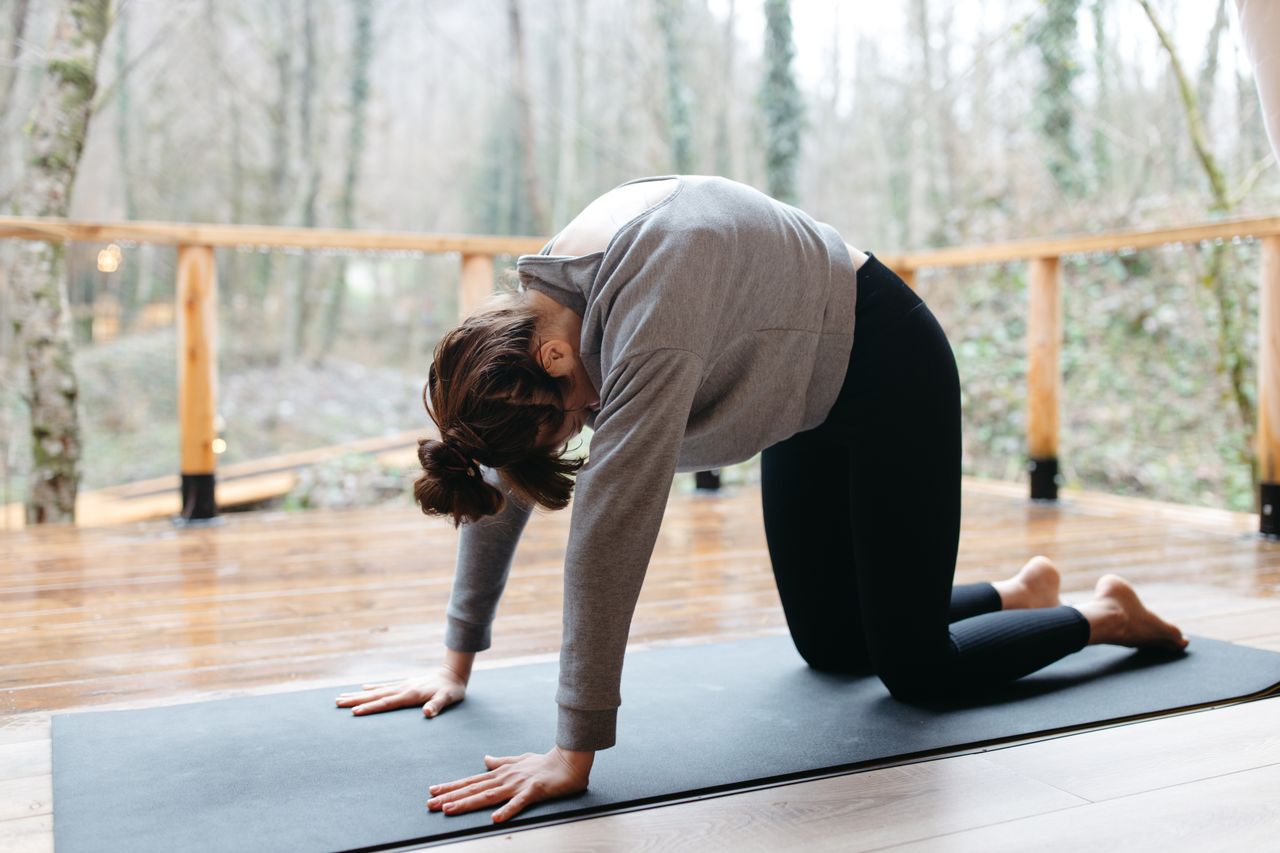
Most people think of back mobility as bending forwards and backwards. The cat camel gives you a gentle way to explore those directions on hands and knees. A lateral trunk stretch asks a different question: how comfortably can you open one side of the body and return? Used together, they give a broader view of movement without requiring a long routine or a promise that stretching will solve the cause of every ache.
After hours at a desk, you might want a few minutes to move in directions you have not used much during the day. Before sport or lifting, you may want to see how the back and sides respond before adding speed or load. The amount of movement appropriate for each situation differs. The sensible starting point is a range you can control and leave easily. A stretch that looks dramatic in a photograph is not necessarily more useful than a small shift that feels comfortable.
Pay attention to side bending
Side bending can be easy to overlook because many back routines concentrate on rounding and arching. When you reach towards one side, the ribs, shoulder, trunk, pelvis and legs all affect the shape you make. A feeling of stretch along the side does not prove that a particular muscle is short. Begin with a small movement and notice whether you can return to standing without a sudden pull. The quality of that return matters as much as the farthest point reached.
The side of the trunk also participates in ordinary tasks. Reaching across a desk, carrying something in one hand or turning to place a bag down may combine side bending with rotation and weight shift. A stretch does not reproduce the load of those tasks, but it can help you explore a comfortable direction. If the side reach is easy but carrying remains painful, adding a stronger stretch may miss the real problem. You may need to look at strength, task setup or the amount of work you are doing.
Add a stretch to the side of the trunk
One supported option is to lie on your side over a Swiss ball, allowing the side of the trunk to lengthen gently. The ball supports some of your weight so you can settle into the position without hanging from a single shoulder. Check that the ball is secure and that you can get on and off safely. The sensation should be mild and spread through the side, not a sharp pressure in one rib, shoulder or part of the lower back.
From there, a more active version uses a wall for support. Place the hands on the wall, step one foot across the body’s midline and let the side of the trunk open as you shift into the position. Return, then repeat with control. This changes the stretch from a held shape to a movement that involves the feet, hips and trunk. The exact reach and step size need not match someone else’s. Begin with a small cross step and enough hand support to keep balance out of the way.
If the aim is to open the right side, a cross step and hand position can create that sensation without wrenching the spine. You should still be able to breathe and return to the start without a sudden pull. If the wall version feels more like a shoulder stretch than a trunk movement, adjust the hand height or make the step smaller. If a side bend creates a sharp local pain, it is not a cue to press farther. Leave that direction out until you know why it is uncomfortable.
The ball and wall versions serve different purposes. A held position can help you notice the sensation of lengthening. The moving version asks you to travel into and out of the range while the feet support you. Neither is inherently superior. Some people dislike lying over a ball, while others do not have one available. The wall option may be easier to fit into a workday, though it still needs space and a stable surface. Choose the version you can perform well and that suits what comes next.
The wall movement can also show whether the stretch is coming from the side you intended. If you reach far with the arms but barely shift the ribs or hips, most of the change may be at the shoulder. If you throw the hips sideways and hold the breath, you may have gone beyond a useful range. Try a smaller step, let the trunk travel gradually and return to neutral before repeating. Make the movement recognisable from one repetition to the next rather than chasing a deeper position.
When using the ball, the aim is a mild, supported sensation rather than hanging your whole body weight over it. Roll only far enough that you can get back upright without pushing hard through a sore shoulder. Someone who does not feel secure getting onto a Swiss ball can skip it entirely and use a standing variation. The difference between a held side stretch and a moving wall reach is worth preserving: one lets you pause in the position, while the other asks for control on the way in and out.
Put the directions together thoughtfully
Cat camel explores gentle rounding and arching on hands and knees, while the lateral stretch explores side bending and some whole-body coordination. You can make a few slow cat camel movements, breathing easily, then stand up and use the wall for a gentle side reach. The existing P4O back mobility guide explains the cat camel in more detail. Here it gives you another direction to compare with the side reach. If you are about to exercise, follow both with a gradual rehearsal of the actual task, such as walking, reaching or lifting.
The way a direction feels may change with the rest of the day. A person who has carried a heavy bag on one shoulder may notice one side more. A long meeting can leave you eager to move, even if no particular tissue is short. Avoid turning every difference into a diagnosis. Ask a more useful question: can you move in and out of the position without fear, sharp pain or a large compensation somewhere else? If so, you have a range worth practising.
Keep the dose modest at first. Several calm repetitions may be enough to learn what each movement feels like. If you spend a long time forcing a stretch and then return immediately to a heavy session, the benefit of the routine becomes hard to judge. Change one thing at a time, such as the size of the wall step or the range of the cat camel. Notice how you feel during the next activity and later in the day. That tells you more than the temporary feeling of a strong stretch.
No one needs a perfectly symmetrical side bend to function well. The shoulder, ribs, hips and feet can all affect the shape of a wall stretch, and people have normal differences. If one side is persistently painful or a new restriction changes how you work or exercise, it is worth asking for a closer look. Trying to push the uncomfortable side until it resembles the other can make the exercise less useful.
When back discomfort needs assessment
New, severe or worsening back pain should not be managed by repeatedly stretching into it. If back pain comes with loss of feeling or movement in a limb, or problems controlling the bladder or bowels, call triple zero (000) immediately and ask for an ambulance. A fever, new weakness or numbness, or difficulty walking with back pain also calls for prompt medical assessment. A mobility routine is not the response to those signs. For recurring discomfort without those warning signs, an assessment can help identify which movements are tolerable and what else may need attention.
At our Collins Street clinic in Melbourne CBD, Principle Four Osteopathy combines movement assessment with exercise rehabilitation. We can look at how the back moves in several directions and how those movements relate to your work, sport or gym training. If a simple stretch keeps provoking symptoms, or you cannot find a comfortable starting range, book online and we can discuss a more suitable plan.