Getting up from a desk, walking to the tram and stepping into a gym session all ask the hips to move, but they do not ask for exactly the same movement. A stretch held on the floor can feel useful after a long day. Before a run or a lifting session, you might prefer to move the leg through a few controlled arcs. The dynamic hip mobiliser and posterior hip stretch offer both approaches. Neither needs to be forced, and neither tells you on its own why a hip feels stiff.
It helps to separate the sensation of tightness from the task ahead. A person who sits through much of a Melbourne CBD workday may simply want to move comfortably before walking home. Someone returning to squats may be trying to find a range they can use under load. The same drill could suit both people, but the reason for doing it and the amount of movement may be quite different. Start with the task you want to make easier, then choose the movement that gives you useful practice.
Move the hip in more than one direction
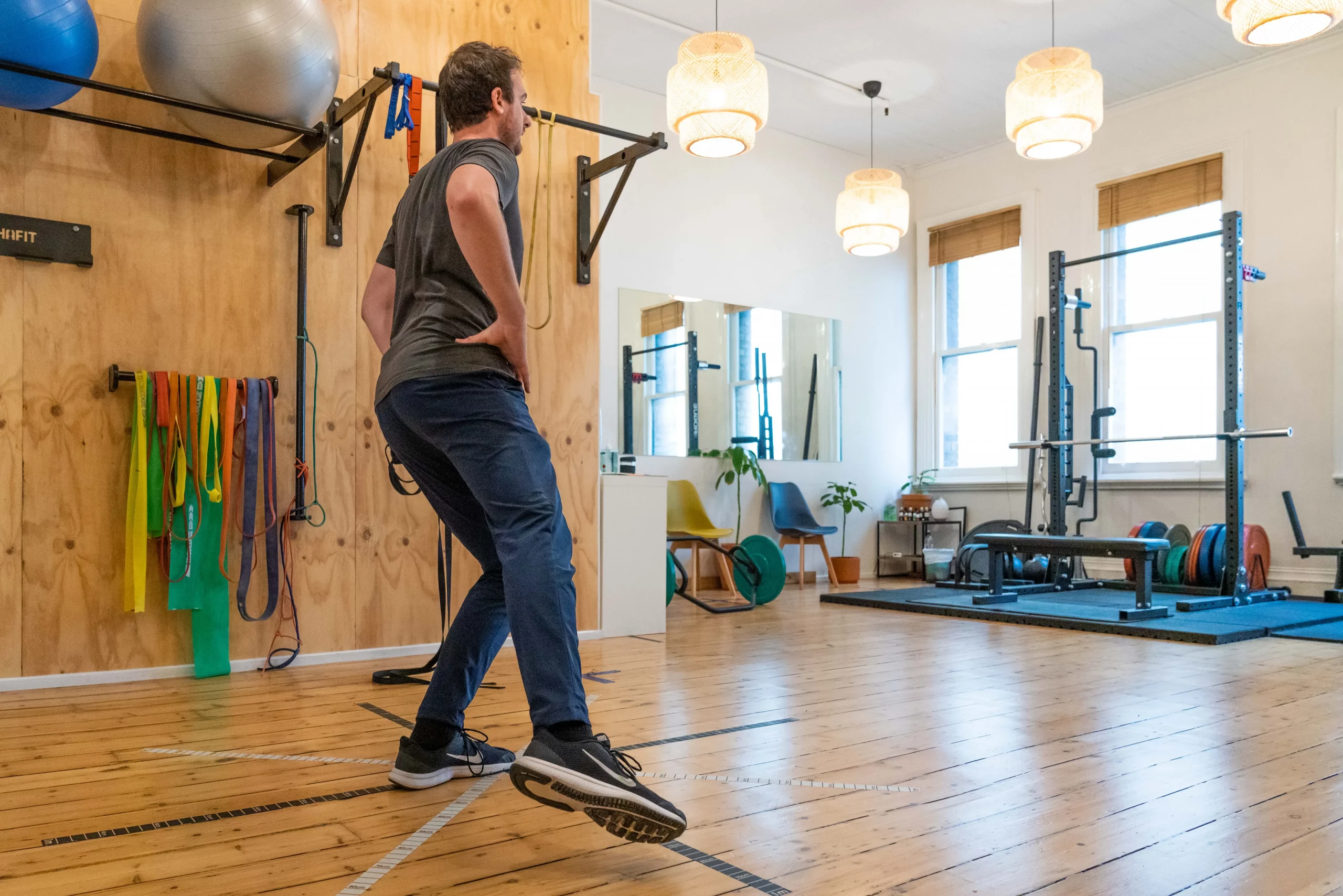
The dynamic mobiliser is built around the fact that the hip does more than swing forwards and backwards. The thigh can travel across the body, away from it and around it. In practice, this means exploring small arcs in several directions rather than doing one large leg swing and calling the hip prepared. Use a stable handhold if balance distracts from the movement. Your standing leg should feel steady enough that the moving leg can do the work.
Begin with an easy forward and backward sweep. Keep the trunk relatively quiet and notice where the movement starts to turn into a lean or a back arch. Then try a smaller side-to-side motion. Finally, explore a gentle turning movement at the hip, letting the leg trace a controlled arc rather than twisting the whole pelvis suddenly. You do not have to combine all three directions into one complicated sequence. Separate them first so that you can tell which range feels comfortable and which one needs a smaller start.
The leg is a heavy lever. The farther it travels from the body, the more effort it takes to control. This is why a small arc makes sense even for someone who is generally fit. If the movement becomes a kick, the person may be using momentum instead of actively guiding the hip. Slow down before making the arc larger. A few well-controlled movements are more informative than a long set that leaves you swinging harder just to reach the same endpoint.
You may also notice that one direction is easier than another. That does not automatically mean something is damaged, out of place or in need of a stronger stretch. The body is not expected to have identical range in every direction. Compare the movement with what you need for walking, getting into a car, climbing steps or training. If a direction repeatedly produces sharp pain or a catching feeling, leave it out and seek individual advice rather than pushing through to make the sides look symmetrical.
Use the floor stretch for a different purpose
The posterior hip stretch is quieter. Start on hands and knees with enough padding or support for the wrists and knees. Extend the right leg behind you and take it across towards the left side of the body, then gently shift the hips left. Reverse the directions for the other leg. Look for a mild pull around the back or side of the hip. The movement should be small enough that you can breathe normally. If the position turns into a sharp pinch in the groin or a strain through the lower back, reduce the shift or stop.
The name of this stretch refers to the back of the hip, but a sensation there does not prove that the joint capsule itself is tight. Muscles, tendons and other tissues can all influence how a position feels. You do not need to work out the exact tissue at home to use the stretch sensibly. A comfortable pull that eases when you come out of the position is enough feedback. More pressure is not a better measurement of progress.
Take a moment to organise the starting position before you move. If the supporting knee slides or the hands are too far forward, you may find yourself balancing rather than exploring the hip. Keep enough weight through the hands and bent knee to make the extended leg light. The hip shift can then be gradual. Let the body return to the centre before repeating or changing sides, instead of dropping into the farthest position and staying there because it feels impressive.
Some people prefer a short hold; others find a few gentle shifts more useful. There is no single duration that makes the stretch effective for everyone. After a long period of sitting, the position may feel different on the first attempt than on the third. If the sensation becomes more uncomfortable rather than settling, that is a good reason to stop. It is also fine to use a different supported hip movement if being on the floor is awkward or impractical during the day.
Choose the version that matches what comes next
For a general movement break, the floor stretch may help you spend a moment in a position you have not used all day. A few dynamic arcs may then make the transition back to walking or stairs feel less abrupt. Before exercise, moving the hip in the directions the session will use is often more relevant than chasing the deepest stretch possible. If you are about to run, a controlled leg sweep and a few easy walking steps can help you judge how the hip responds. If you are going to lift, a gradual practice of the actual squat or hinge still matters.
These drills can sit beside strength work; they do not replace it. Comfortable range is only one part of what makes a movement useful. The hip also has to produce force and manage the load of the task. Someone may be able to reach a position on the floor but find it hard to control when standing on one leg. Another person may have plenty of strength but feel uncertain moving into a new range. That difference is why a mobility session and a training session should inform each other rather than compete.
Keep the experiment simple. Change one aspect of the movement at a time: direction, size of arc, number of repetitions or amount of support. If you change everything in a single session, it is difficult to tell what helped and what irritated the hip. Notice how you walk afterwards and how the next activity feels. The useful range is one you can enter, control and leave without needing to brace or hurry. There is little value in a wider arc if the body has to twist around the hip to create it.
Know when the hip needs more than a mobility drill
Hip pain can come from several places, including the hip joint, surrounding tissues or even the back. A new, severe or worsening problem deserves an assessment instead of a more aggressive stretch. Get prompt medical advice if pain follows a fall, you cannot put weight on the leg, the hip becomes markedly swollen or you feel unwell with fever. Those situations call for care that a mobility routine cannot provide.
For a less urgent concern, look at the pattern. Does the hip object to a particular direction, to sitting for a long time, to the first steps after rest or to a specific lift? Does the discomfort settle when you reduce the range or the load? Those details help a clinician work out what is worth checking and which movement is sensible to practise. They are more useful than deciding that every feeling at the back of the hip must be a tight capsule.
At Principle Four Osteopathy, our Collins Street team can assess movement and help match exercise rehabilitation to the activity you want to return to. That may mean adapting one of these drills, building strength around the hip or choosing a different starting point. If the hip keeps limiting your walk, workday or training, you can book an appointment online to talk it through.