
A horizontal row can be as simple as pulling a dumbbell towards the ribs with one hand on a bench, or as demanding as lifting your body towards suspension handles while your feet rest on a wall. The movement family is broad, and the hardest-looking version is not automatically the most useful. A good row lets you load the back and shoulders at a level you can control while the trunk supports the position you have chosen.
This is especially relevant when a programme already contains plenty of pressing. Pulling work can give the upper back a clear role, but it does not have to follow a universal ratio to push-ups or bench presses. The amount and type of rowing should reflect your other training, your shoulder comfort and the equipment available. A Melbourne CBD worker who trains for half an hour after work may choose a straightforward supported row. A more experienced lifter might be ready for the additional whole-body challenge of a TRX variation.
This article was written by osteopath Heath Williams of Principle Four Osteopathy. Principle Four Osteopathy is one of Melbourne City CBD leading osteopathy clinics. We are located on Level 4 of 178 Collins St (within Pleasance House) alongside Optimal Health Exercise Physiology. We have a fully equipped strength and conditioning exercise rehab space with osteopathic consult rooms. Our team of osteopaths have an interest in manual therapy, strength and conditioning, exercise rehabilitation and ergonomics. Read more about our team here. Book an appointment online here or call us on 0396709290 to arrange an appointment.

Start by choosing the support
A one-arm dumbbell row with the other hand supported on a bench gives you a stable base. You can focus on drawing the elbow towards the body and returning the weight with control. The bench helps reduce the need to hold a bent-over position for the entire set. Keep enough room for the shoulder blade to move rather than trying to clamp it in one place. If the torso twists dramatically to lift the dumbbell, the load may be too high for the job you intended.
A chest-supported row offers even more support through the trunk. That can be useful when you want the upper back to work but do not want balance or a long hip hinge to limit the set. It is still possible to pull with a jerky movement, so support does not replace control. Let the arms reach within a comfortable range, then draw the handles or weights back without heaving the chest off the pad. The stable position can make it easier to compare one repetition with the next.
A bent-over barbell row asks for more coordination. The hips hold a hinge while the arms pull, and the trunk has to manage the load throughout. If the weight rises and the torso becomes more upright with each repetition, you may be using momentum instead of training the intended row. Reduce the load or choose a supported option. There is no need to earn the right to row by starting with the barbell; the best starting exercise is the one that lets you practise the movement well.
Seated cable rows and kneeling or standing versions add other choices. A cable may let you change grip, direction and amount of trunk movement. Those are useful adjustments when they serve a goal, but too many changes at once make the exercise hard to judge. First find a pull you can repeat without shoulder pain or a large swing. Then alter the grip or position if it improves the fit. The label “horizontal pull” describes a family, not one perfect technique that every person should copy.
Understand what the TRX changes
In a standard TRX row, hold the straps and lean back so the body forms a line while the feet remain on the floor. Pull the chest towards the handles, then lower with control. The closer the body is to horizontal, the more of your body weight you have to lift. You can alter the angle without changing equipment. This makes the TRX flexible, but the trunk must stay organised so that the hips do not sag or shoot forward to help the pull.
Foot position also changes the exercise. A wider stance can offer more stability; a narrower one may ask more of the trunk. You can adjust the angle and stance separately to see which change matters. Do not make the body nearly horizontal and remove foot support in the same step if either version is new to you. A clear progression lets you notice where the upper back works and where the movement starts to break down.
The wall-foot variation is more advanced. With the feet placed on a wall and the body suspended roughly parallel to the floor, the person must hold trunk tension while pulling towards the handles. There is less familiar floor support. The setup also requires a secure anchor, suitable footwear and enough space to enter and exit safely. Do not attempt it because it looks impressive in a short clip. Practise a simpler TRX row first and ask for help with the wall setup if you have not used it before.
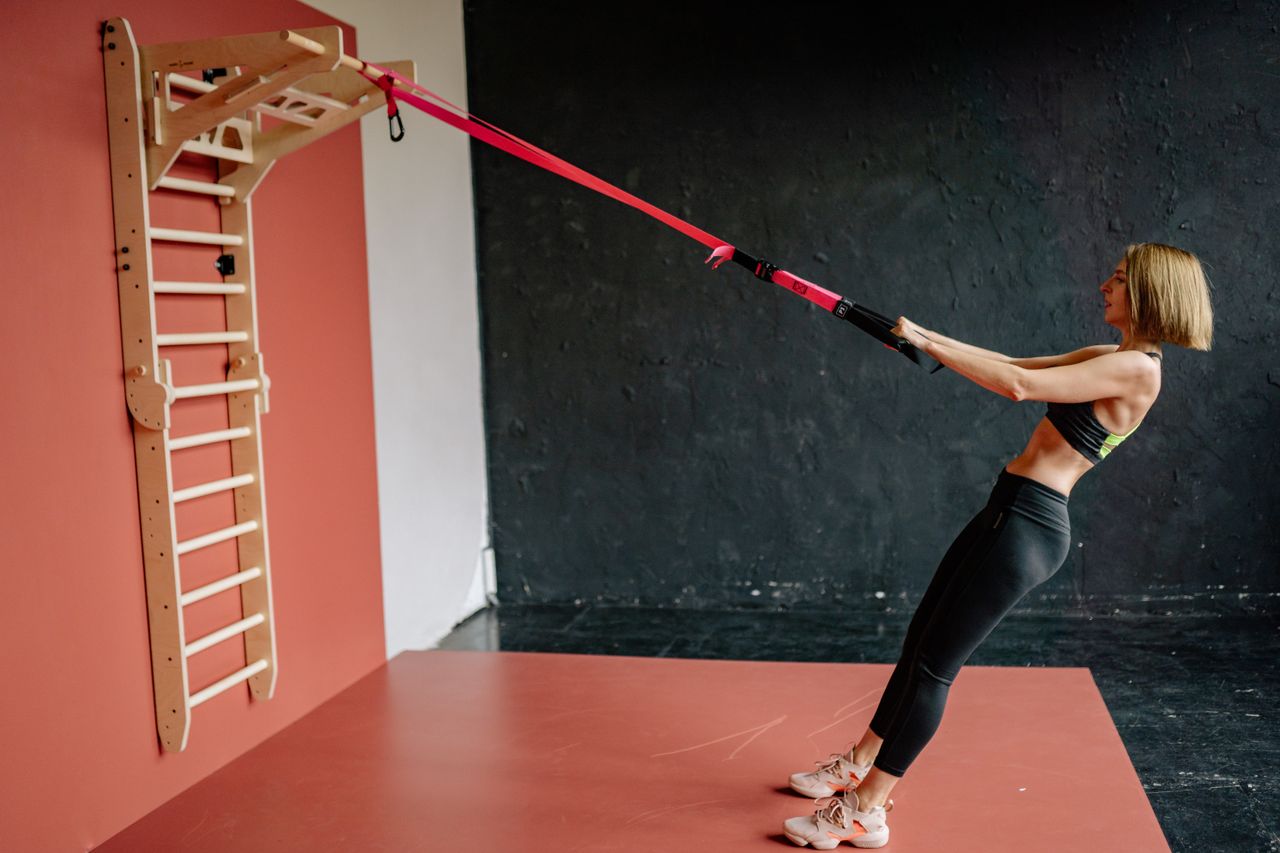
At that level, the row becomes a whole-body task. The arms and upper back still pull, but the hips and trunk work to stop the body folding or swinging. If the feet slip, the hips drop or the shoulders shrug towards the ears, the position may be too difficult to give the back a useful training load. Return to feet on the floor or a more upright angle. You can make strong progress without ever using the wall-foot version.
Progress the pull without losing its purpose
Choose one feature to change at a time. With a dumbbell row, it might be a small increase in load after the path feels consistent. With a TRX row, it might be a slightly lower body angle. With a chest-supported row, it could be an extra controlled repetition. These are all progressions, but they do not need to happen together. If you suddenly change the grip, angle, speed and load, it becomes difficult to know why a shoulder feels different afterwards.
The return phase is worth attention. Lower the weight or body at a pace you can control. If the shoulders are pulled forward abruptly at the bottom, reduce the difficulty. If you shorten every repetition to avoid a difficult portion of the range, check whether a lighter version would let you move more naturally. A useful row need not have the largest possible range, but it should be repeatable and relevant to the goal you are training.
Think about elbow position rather than forcing a single angle. A close elbow path may feel different from a wider one, and different grips can change comfort. Neither variation is universally correct. Try one adjustment at a time, especially if a shoulder has been sensitive. If a wide pull produces pinching, reduce the range or choose a closer path. The ability to adapt a row is one of its strengths; you do not have to persist with a setup that irritates the joint.
Rowing also sits within a programme. If you already lift, climb or do physical work, your upper back may have substantial pulling exposure. If you mostly press and rarely pull, adding a manageable row can make the week more balanced in a practical sense. That does not mean a precise pull-to-push ratio prevents injury. It means you can make sure a movement you value is actually being trained, rather than assuming it will take care of itself.
Match the row to the person
For a new gym member, the best row may be the one with enough support to learn the arm path. For a runner seeking general strength, a simple one-arm or cable row may fit beside leg training without dominating the session. For a person who enjoys bodyweight training, the TRX can offer a progression by changing the angle. None of these choices is a verdict on strength or fitness. They are different ways to solve the same training problem with different demands on the trunk.
If rowing produces sharp shoulder pain, marked weakness, tingling or discomfort that keeps worsening, stop and seek advice. Pain after a fall, visible deformity or sudden loss of movement warrants prompt medical assessment. For less urgent but persistent symptoms, an assessment can look at the shoulder and the whole pulling task rather than blaming one grip or one muscle.
At Principle Four Osteopathy, movement assessment and strength and conditioning can help you choose a row that fits your goals and current capacity. That might be a simpler angle, a supported position or a different amount of work within the week. If you want to return to pulling exercises with more confidence, book online to see our Collins Street team.