Why Shoulder Rehab Often Plateaus — And How Clinicians Can Progress Patients Further
Advanced Exercise Prescription for Physios, Osteos, EPs & OTs
Most clinicians have experienced this scenario.
The patient improves initially.
Pain reduces.
Range improves.
Daily activities feel easier.
Then progress stalls.
Weeks later they return saying:
“It’s better… but not normal.”
This plateau is one of the most common frustrations in shoulder rehabilitation — not because treatment is wrong, but because progression strategy is unclear.
And it usually occurs at the same stage of recovery.
The Early Phase Is Straightforward
Most clinicians are confident with:
- Mobility exercises
- Isometrics
- Basic strengthening
- Scapular control drills
These interventions work well early because they reduce sensitivity and restore movement.
But shoulder rehab rarely fails early.
It fails later.
Where Shoulder Rehab Becomes Difficult
The challenge begins when the patient needs to return to:
- Gym training
- Repetitive work tasks
- Sporting loads
- Sustained overhead activity
At this stage the question changes from:
“Can the shoulder move?” to“Can the shoulder tolerate load?”
And this is where many programs become repetitive instead of progressive.
Why Many Programs Stall
A common pattern occurs:
- Exercises improve symptoms
- Symptoms stabilise
- Exercises continue unchanged
- The shoulder adapts quickly to predictable load.
- Without progression, capacity stops increasing.
- Patients remain functional — but limited.
The Missing Link: Load Strategy
Shoulder rehab isn’t just selecting exercises.
It requires understanding:
- Load direction
- Force vectors
- Movement arcs
- Fatigue exposure
- Task specificity
Two patients may perform the same exercise but experience completely different adaptation.
This is why progression is a clinical reasoning problem — not an exercise list problem.
Closed Chain vs Open Chain Is Not Enough
Many clinicians rely on simple progressions:
- Band → dumbbell
- Supported → unsupported
- Light → heavy
But real-world tasks rarely follow linear patterns.
Daily activity and sport involve:
- Combined planes
- Changing stability
- Variable resistance curves
- Rehabilitation must eventually resemble these demands.
What Determines Successful Return To Activity

Patients succeed when programs progressively expose them to:
- Force in multiple directions
- Speed changes
- End-range loading
- Fatigue tolerance
- Without these, the shoulder remains symptom-controlled rather than capacity-built.
Why This Matters For Clinicians
The difference between temporary improvement and full recovery is often progression planning.
Patients who plateau:
- Return frequently
- Lose confidence
- Avoid activity
- Become chronic presentations
Patients who progress:
- Self-manage successfully
- Return to activity sooner
- Require fewer sessions
Bridging The Gap Between Rehab And Performance
Traditional rehab restores function.
Advanced rehab restores tolerance.
This requires understanding how to:
- Modify range
- Adjust leverage
- Change resistance curve
- Sequence exercise stages
These decisions cannot be memorised — they require a framework.
The Clinical Challenge
Most university training teaches pathology recognition.
Few programs teach structured progression strategy.
Clinicians often develop it through years of trial and error.
There is a faster way.
Shoulder Strength & Conditioning For Clinicians
The shoulder girdle course focuses specifically on applying strength and conditioning principles to rehabilitation.
It teaches clinicians how to:
- Progress exercises logically
- Modify movement based on irritability
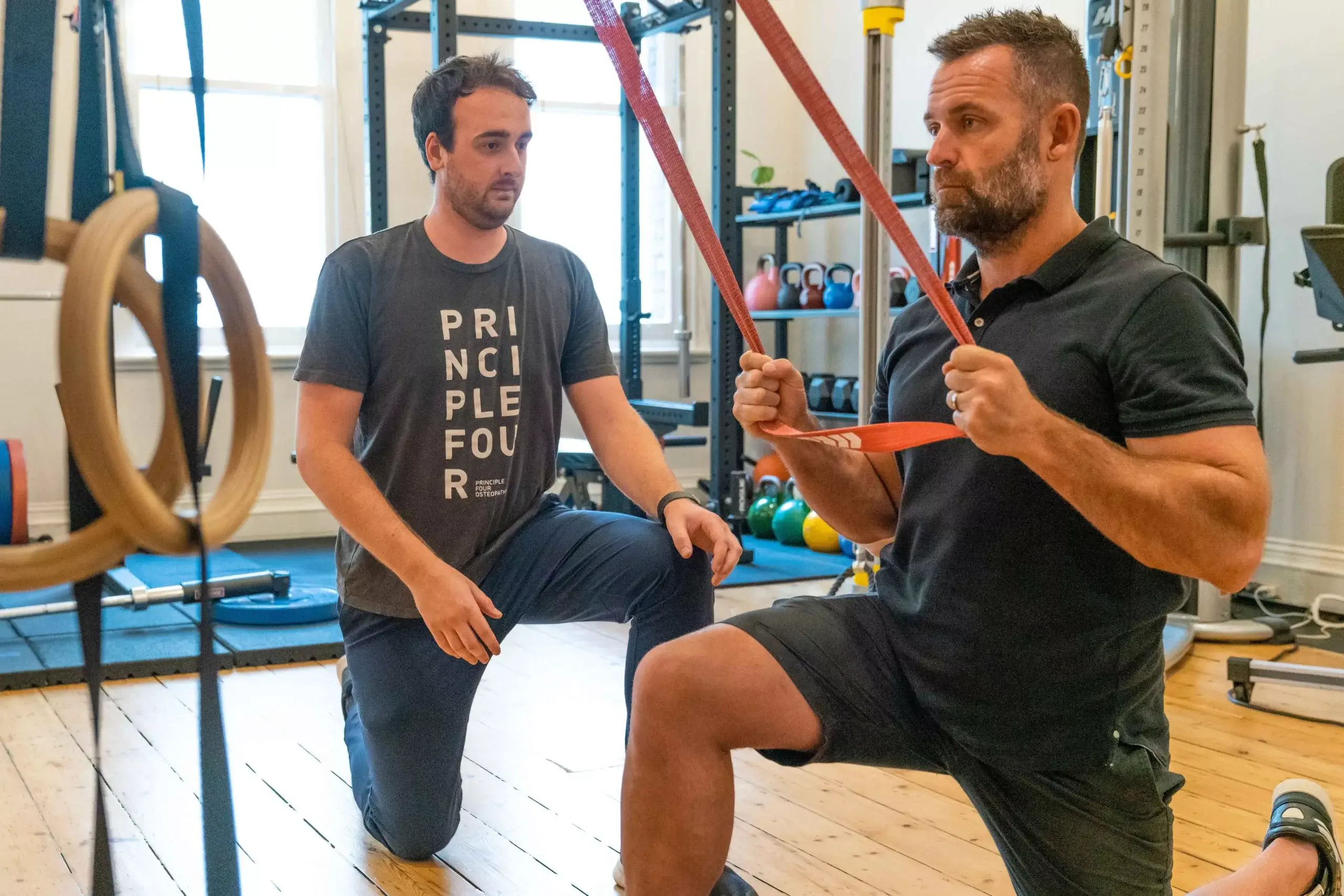
- Apply open and closed chain loading
- Adapt programs for performance goals
👉 View the course
The course is designed for clinicians managing shoulder musculoskeletal complaints and includes exercise prescription strategies, case examples and practical demonstrations.
Who This Is For
This training suits clinicians who:
- Treat shoulders regularly
- Prescribe gym-based rehab
- Work with active patients
- Want better progression confidence
Physios, osteopaths, exercise physiologists and occupational therapists commonly use it to improve later-stage rehabilitation.
What Clinicians Gain
After completion clinicians typically:
- Progress patients more confidently
- Reduce plateau presentations
- Improve return-to-activity outcomes
- Use fewer repetitive exercises
The goal is not more exercises — it is better decision making.
Practical Application Immediately After Learning
Because the course is case-based, most clinicians implement changes the next day.
You learn how to think about progression — not memorise protocols.
Learn today, implement tomorrow.
👉 Access the shoulder rehabilitation course
Expand Your Clinical Skillset
If you regularly manage shoulder pain, your results depend less on diagnosis and more on progression strategy.
Understanding load is what moves patients from recovery to performance