Getting comfortable with floor exercise involves more than holding a plank for longer. The shoulders have to support body weight, accept a shift from one hand to the other and recover when the position changes. P4O’s wall-to-high-plank exercise brings those tasks together in a demanding transition. A low-to-high reverse cable fly offers another kind of shoulder work, with the hands moving freely against resistance. Used thoughtfully, the cable exercise can complement the support work without pretending to train exactly the same skill.
The practical question here is whether your shoulder is ready for the amount of support a floor task asks of it. A person may be able to pull a cable smoothly yet find a plank uncomfortable through the wrist or front of the shoulder. Another may hold a plank easily and struggle with a wide arm movement. These differences are reasons to choose a starting task carefully. Neither a long wall hold nor a heavier cable stack proves that the next floor exercise will be easy.
Build support in positions you can leave safely
Begin at a wall with both hands planted and the feet far enough back for a comfortable lean. Check whether each palm can accept pressure while you breathe and whether you can step away without a jolt. A brief alternating hand lift adds a modest shift of body weight. If you cannot keep the supporting shoulder comfortable, bring the feet closer or stay with both hands on the wall. This is a practical check of support, not a race to reach the floor.
Next, use a secure, fixed raised surface if one is available. Place both hands on it and find a body angle you can hold without wrist, shoulder or back pain. Try a small change of weight between the palms while both hands remain planted. The support is lower than a wall, so the arms take more of your weight. Keep the effort short enough that you can step out cleanly. If the surface shifts, is too narrow or places you near a sharp edge, it is unsuitable; choose a safer support.
The floor high plank is another separate position to learn. Put the hands beneath or slightly wider than the shoulders and choose a foot position that lets you keep the hips reasonably steady. Start with a few breaths, then come out under control. If one arm suddenly bears most of the weight, shorten the hold or widen the feet. You do not need to move from wall to floor in one continuous repetition to get useful work from either position. The ability to enter, hold and leave each one matters first.
Only after those positions feel familiar does the wall-to-high-plank sequence become a reasonable option to discuss. Moving between wall and floor changes the hand height, foot position and body angle at once. The exact route depends on space and the person’s reach; it needs a demonstration and a check of how you get back up. Treat that full transition as a coached variation. It is not required for someone whose goal is simply to build shoulder tolerance for an ordinary floor plank.
When a clinician or coach has shown you a suitable route, pay attention to the moments when a hand leaves its support. The other arm briefly has a larger job, and the trunk may turn to avoid that load. The useful version is slow enough that you can stop if a shoulder feels crowded or the body falls out of line. If you have to use momentum to cover the height change, return to the separate wall, raised-surface and floor exercises. A smaller task you can repeat is more valuable than an impressive transition you cannot control.
Keep the cable work in a supporting role
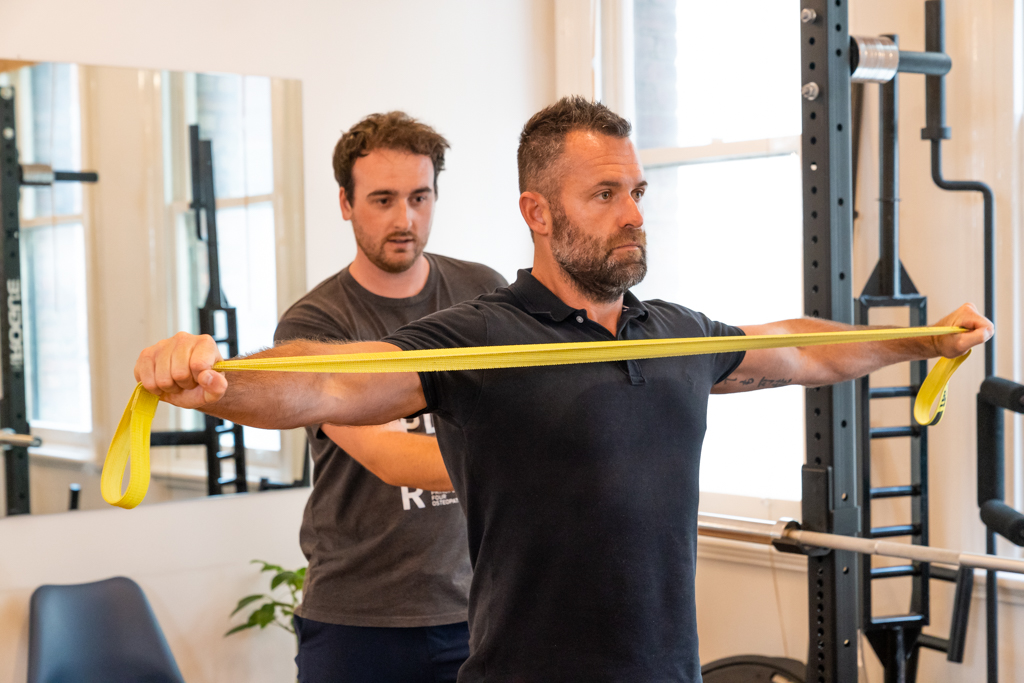
The reverse cable fly adds a light outward and upward pull for the back of the shoulders and upper back. Its value in this plan is variety of load, not proof that the shoulder is ready to support body weight. The hands move while the torso stays fairly still; a plank reverses that relationship. If you already do plenty of pulling, this extra exercise may be unnecessary. If your week is mostly hand-supported or pressing work, a modest set may be useful alongside it.
Keep its range and load easy enough that the shoulders remain comfortable. If the wide arc is awkward, shorten it or leave the fly out. Do not increase the cable weight to compensate for a difficult plank, and do not assume that easy cable repetitions mean the floor transition is ready. These are separate demands with separate starting points. P4O’s pulling and pressing guide covers the broader upper-body balance; the concern here is specifically how the shoulder handles weight through the hands.
Consider the order if both appear in one session. If floor support is the skill you are learning, practise it while you are fresh enough to notice a shift in weight between hands. A light cable set can follow if the shoulders still feel comfortable. If the cable exercise is the priority for another reason, reverse the order or place the plank work on a different day. The aim is to give each task enough attention, not to complete a fixed pairing every visit.
Fit both into a week that already has demands
If you work in Melbourne CBD and train before or after a long workday, the session may need to be simple. You could choose a few short wall hand shifts or a steady floor hold, then add a light cable fly if it serves the session. Someone returning from a shoulder problem may start with only one task. A person who already performs push-ups, rows and overhead work may not need extra sets of both. The right amount depends on what the shoulder is already doing, not on a universal push-to-pull formula.
Think about the rest of your week as well. A physical job, swimming, climbing or regular pressing can change how much shoulder load feels manageable. If you add these exercises, keep the other training familiar for a while so you can see how the new work affects you. Make a note of whether soreness settles, whether ordinary reaching remains comfortable and whether the next session feels repeatable. Adding variety is useful only if it does not obscure a workload that is already too high.
Progress does not have to mean moving to the floor faster or increasing the cable stack. You may first become more even between left and right hands, breathe more easily during the transition or keep the cable arc smoother. Those changes are worth noticing. When the task feels familiar, a modest increase in range, repetitions or load may make sense. If control disappears with the change, return to the earlier version and give the shoulder more time to practise.
The two movements also offer a way to talk about goals. Someone preparing for floor-based exercise needs confidence supporting body weight. Someone wanting more upper-back work may get more from the cable. If both goals matter, neither exercise has to dominate the session. The best programme includes the movements you can do well and the ones that serve the activities you care about, not every drill that happens to involve a shoulder.
Muscle effort and ordinary fatigue are expected with strength work. Sharp pain, a feeling of instability, tingling or a loss of movement is different. Stop the exercise and seek advice if those occur. If pain follows a fall, the shoulder looks deformed or suddenly becomes very weak, seek medical assessment promptly. A harder set of cable flys will not explain or resolve that kind of problem.
At Principle Four Osteopathy, movement assessment and exercise rehabilitation can help identify a tolerable way to load the shoulder and relate it to your work or training. That might involve changing the height of the support, practising the high plank separately, adjusting the cable path or choosing another exercise. If you are unsure how to progress after shoulder discomfort, you can book an appointment online at our Collins Street clinic.