When your feet move in a plank, keeping the rest of the body steady becomes a different job. The TRX pendulum swing makes that obvious: the feet sit in suspension straps while the legs travel from side to side. A wall plank asks much less of the body, but it gives you a chance to notice how the shoulders, trunk and hips respond when a point of support changes. Together, the two exercises show how to build control before adding a large moving lever.
There is no reason to treat the wall and the suspension straps as consecutive levels that everyone must complete. Someone with a sore wrist or shoulder may need a different route altogether. Someone who already trains on the floor may use the wall for a brief rehearsal rather than a long programme. What links these movements is a practical question: can you allow one part of the body to move without letting every other part follow it?
Check the support before the swing
If supporting weight through the hands is unfamiliar, the wall plank in the linked demonstration is a gentler place to begin. Its brief alternating hand lifts show what happens when one point of support changes. For this guide, the wall has a limited job: check that you can bear some arm weight and breathe without pain before considering a floor-based suspension exercise. It cannot confirm that you are ready for the pendulum. You still need a comfortable floor plank, secure straps and a way to enter and leave the position safely.
Understand what the TRX swing adds
In the pendulum swing, place both feet securely in the suspension straps and begin in a high plank with the hands on the floor. Keep the feet together as the legs move slowly to one side and then the other. The straps allow the lower body to swing, but the intention is not to throw the legs as far as possible. The movement should be controlled enough that you can stop and reverse direction without the hips dragging the torso into a large twist.
This is a demanding setup. The shoulders and hands bear weight while the legs become a moving lever. The trunk has to manage the pull from the straps, and the return from each side can be harder to control than the outward swing. Begin with a small arc and a short set. If the feet keep separating, the knees buckle or the shoulders collapse, the movement has moved beyond the range you can currently manage. The straps do not make a plank more valuable merely because they make it less stable.
Pay attention to what happens just before the legs change direction. Momentum can make the first swing feel easy, then carry the hips farther on the next one. Slow the return until you can pause near the middle. The spine does not need to be perfectly motionless, but the movement should not be driven by a sudden jerk through the lower back. If the trunk rotates more than you intend, reduce the swing. A smaller, repeatable arc is better training than a dramatic sweep you cannot bring back under control.
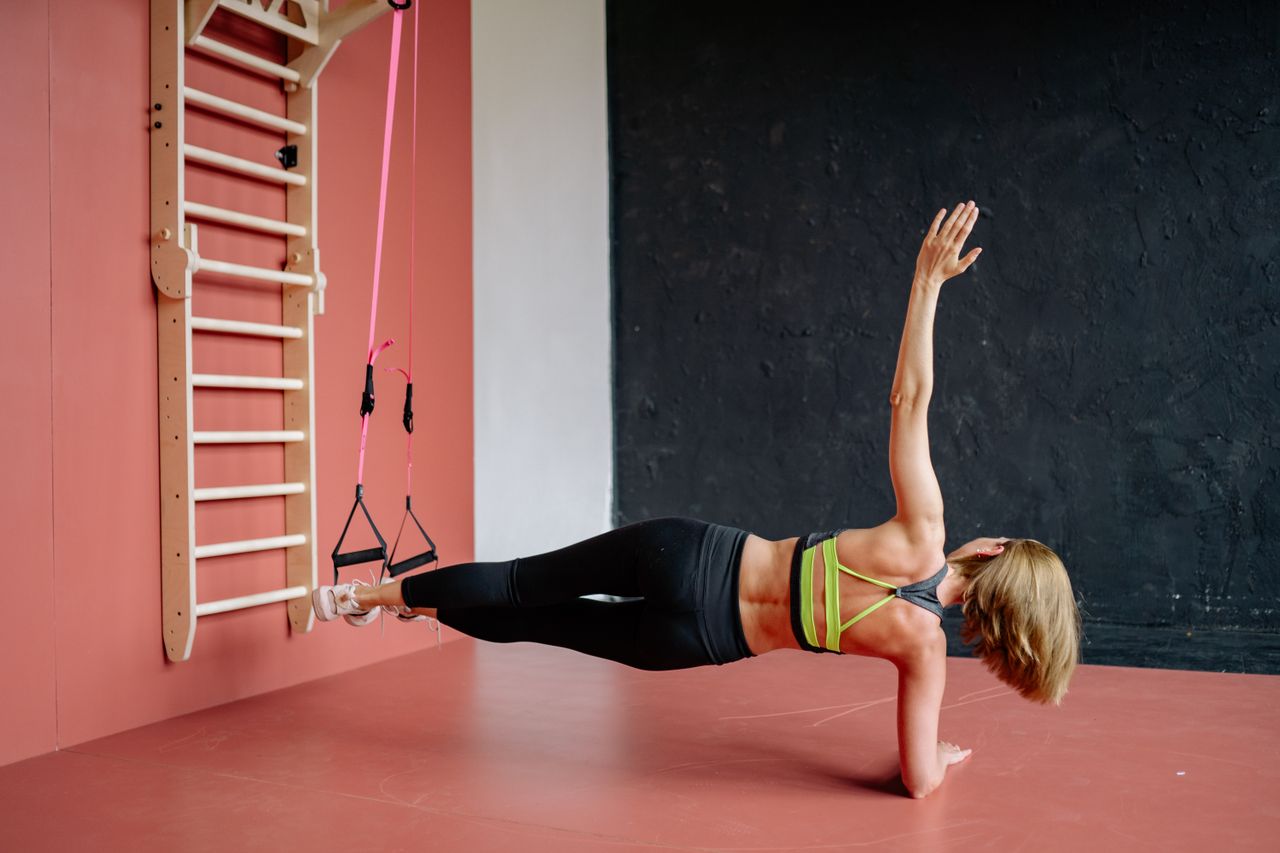
One useful way to learn the swing is to treat the centre as a stopping place. Move the joined legs a little to one side, bring them back, pause, and only then explore the other side. This is different from letting the straps trace a continuous pendulum that never settles. The pause gives you a chance to notice whether the shoulders have crept forwards or the hips have rotated under you. If they have, reset before the next swing. A few deliberate crossings can be enough to make the task challenging.
Notice whether one direction feels harder to stop. It might be the outward travel, the return to the centre or the moment the straps change direction. Those are different parts of the exercise. Rather than swinging farther on the easier side to compensate, choose the smaller range you can control on both sides. The straps can move smoothly even while the body loses its position, so watch the hands, shoulders and pelvis together. A brief video or a coach’s view from behind may help reveal a change you cannot feel during the set.
The feet being held together in the straps changes the task from an ordinary mountain climber or side step. Both legs act as one lever, and a small shift at the feet can ask a lot of the trunk when the body is long. Shortening the travel, taking a longer pause or ending the set earlier changes the demand without changing the equipment. If the legs separate or the knees bend to rescue the swing, return to a simpler plank task before adding more suspended repetitions.
Before trying the straps, make sure the anchor is secure, the floor gives your hands reliable grip and you can enter and leave the position safely. If you are unsure how to set up a TRX, ask for a demonstration. There is no benefit in learning the movement while also worrying whether the equipment will shift. If a regular high plank is already uncomfortable, suspended feet are unlikely to improve the situation. Work with a supported variation first or choose another exercise.
Connect the two without rushing the progression
The wall plank gives feedback about weight transfer at the shoulders; the pendulum asks you to manage movement at the feet. Between them are many useful options. A floor plank with both feet on the ground, a gentle weight shift through the hands or a slow step to one side can all help you explore the same question with less equipment. You do not need to perform each option in a strict order. Choose the one that exposes a manageable challenge while preserving control.
It helps to keep the goal specific. If your sport involves quick changes of direction, the eventual training programme will need more than a suspension exercise. If you are returning to gym work after a break, a stable plank may give you enough of a starting task. If you spend a lot of the day at a desk in Melbourne CBD, you might use the wall as a short movement break, then save harder floor work for a planned session. The exercise should fit your week, not crowd out the rest of it.
Look for small signs of progress. Can you return the suspended legs to the centre without a second, uncontrolled swing? Do both directions settle at a pace you choose? Can you keep breathing while the task changes? Those observations tell you more about control than adding ten seconds to the timer every session. Keep the range and pace consistent before increasing either. Change one feature at a time so that you can tell whether the body is adapting to the movement or simply surviving it.
Fatigue changes this exercise quickly. A pendulum that looks controlled for the first few swings may become a series of shoulder shrugs and hip drops later in the set. Stop while you can still recognise the intended movement. More repetitions are not useful if the last half of the set is a different exercise. On another day you can add a little time, provided the previous dose settled well and did not leave a shoulder or back problem that interrupts ordinary activity.
Muscle effort is expected in a challenging plank. Sharp pain, numbness, a feeling that the shoulder will give way or back symptoms that spread into the leg call for a different response. Come out of the straps and seek advice about what is happening. New or worsening pain after a fall, marked weakness or an inability to move comfortably deserves medical assessment rather than a harder core routine.
For recurring but less urgent discomfort, the useful question is often where the task breaks down. Is it the wrist under load, the shoulder at the bottom of the plank, the swing to one side or the return to the middle? A clinician can use that information to check the movement and suggest a suitable variation. The answer may involve changing support, range or training load rather than trying to brace harder.
At Principle Four Osteopathy, we can assess how you move and help place trunk exercises within a broader rehabilitation or strength programme. If you are unsure whether the wall, the floor or the suspension straps suit your current stage, book an appointment online at our Collins Street clinic and we can work through the options with you.